History is not a preamble to Europe
Civilisational history belongs to humanity as a whole, not to an imperial teleology that treats the rest of the planet as a waiting room for European arrival.
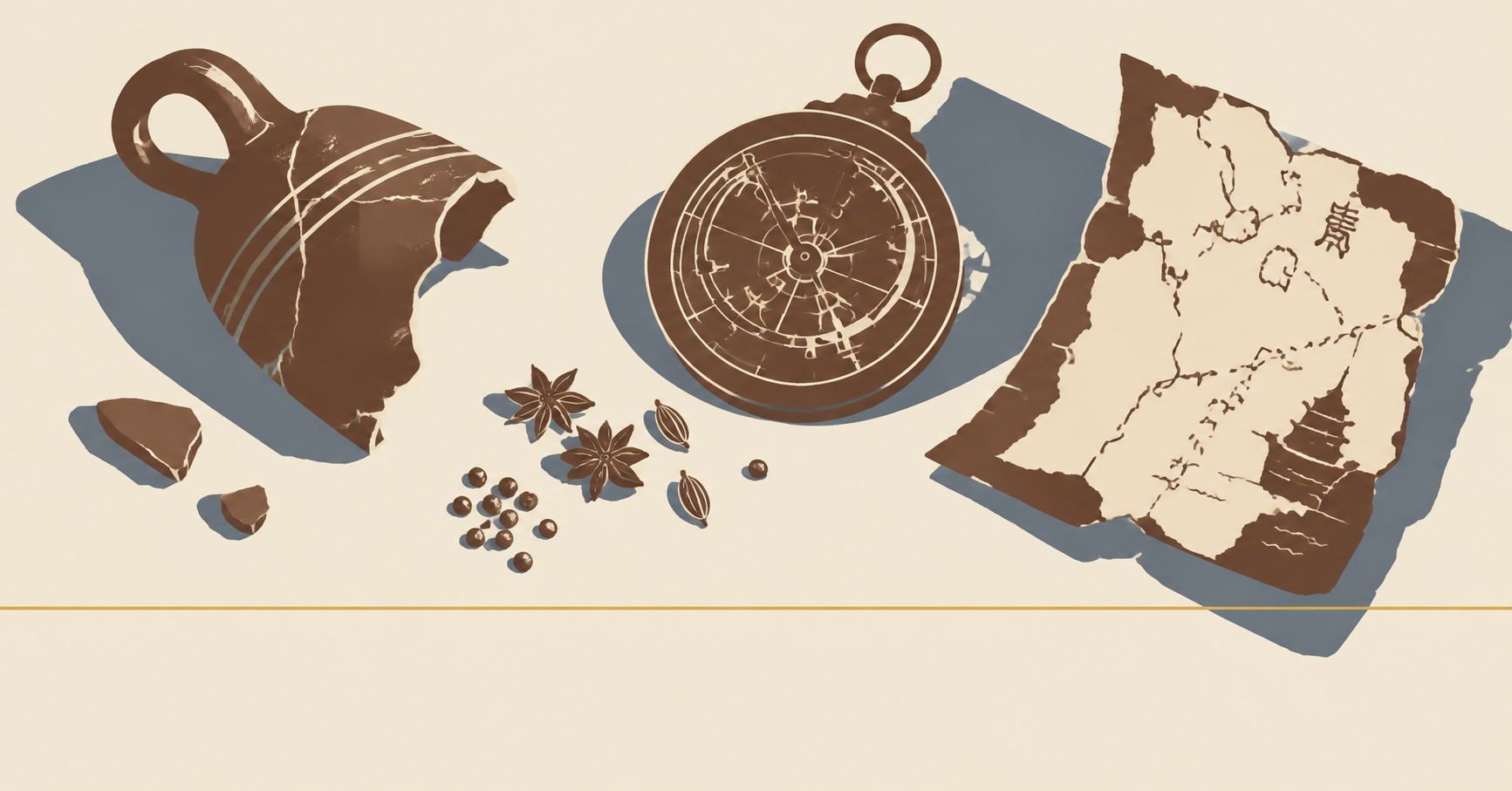
Most history curricula in Britain still run on a single teleological track. You begin with the Fertile Crescent, take a brisk walk through Athens, pause for Roman administrative plumbing, endure the Dark Ages, and arrive promptly at the Renaissance. From there, the narrative picks up speed through the Enlightenment and the Industrial Revolution. Everything outside that corridor is treated as scenery.
Civilisations across Asia, Africa, and the Americas appear only when a European vessel bumps into them. Until that contact occurs, those societies are framed as dormant. They sit in a historical antechamber, static and unrecorded, waiting for someone from Lisbon or Bristol to write down their names.
This framing is absurd. The centuries of human experimentation with law, metallurgy, agriculture, and urban planning were not a rehearsal. They were the main event.
Civilisational history belongs to the species as a collective whole. When school syllabuses collapse that breadth into an unbroken march toward Western supremacy, they do not offer an education. They hand down an unexamined colonial perspective disguised as an objective timeline.
The centuries of human experimentation with law, metallurgy, agriculture, and urban planning were not a rehearsal.
Consider the standard treatment of medieval global trade. In most classrooms, the Indian Ocean before the late fifteenth century is treated as empty water waiting for Vasco da Gama. Yet for centuries prior, monsoon winds carried Arab, Persian, Gujarati, Swahili, and Malay merchants across a sophisticated maritime network. They exchanged goods, shared navigational techniques, and developed complex commercial credit systems without central oversight or gunboat diplomacy.
The arrival of the Portuguese did not introduce commerce to the region. It introduced violence to an established mercantile order. When da Gama demanded that the Zamorin of Calicut expel Muslim traders, he was not initiating global trade. He was attempting to monopolise it through naval artillery.
The Americas suffer the same pedagogical flattening. School textbooks still speak of pre-Columbian civilisations as though their only purpose was to provide gold for Spain or die of smallpox on cue. Tenochtitlan had complex engineering, sanitation systems, and public hygiene that surpassed contemporary European capitals. Yet Mesoamerican history is routinely reduced to a brisk chapter on sacrificial rites, serving as a moral justification for the conquest that followed.
West Africa is treated with similar disregard. The Kingdom of Benin produced bronze casting techniques of such precision that nineteenth-century British curators initially refused to believe Africans had manufactured them. The British coloniser stripped the city of its art during the 1897 punitive expedition, shipped the works to London, and catalogued them as imperial spoils. The political, artistic, and administrative complexity of Benin was simply folded into the archive of imperial plunder.
When an entire worldview assumes the world outside the West was passive until conquered, it normalises modern forms of extraction.
This historical distortion is not an innocent artefact of old textbooks. It shapes modern political reflexes.
When Western institutions debate international law, technological governance, or economic aid today, they routinely assume they are bringing order to inherently chaotic peripheries. International development rhetoric still carries the paternalist assumption that modern systems must be exported from an enlightened centre to an underdeveloped margin. The language has shifted from civilising missions to capacity building, but the underlying assumption remains identical.
The modern tech industry exhibits the same structural arrogance. Silicon Valley routinely presents digital platforms as gifts of infrastructure to regions that supposedly had nothing before venture capital arrived. When global software firms enter African or South Asian markets, they describe themselves as pioneers building on blank slates. They ignore existing informal economies, community lending networks, and local communications systems that operated long before their servers were switched on.
The same instinct governs the climate conversation. Industrialised nations lecture the global south on sustainability as though ecological stewardship were an invention of twentieth-century European conferences. Indigenous agricultural management and ancestral water conservation systems are ignored until they can be repackaged as innovative carbon offset programmes managed by Western consultancies.
Treating global history as a preamble to European modernity produces an intellectual deficit. It leaves generations unable to comprehend a multipolar world because they were taught that only one pole ever mattered.
History is not an escalator leading to Europe. It is a vast, interconnected network of human societies that traded, built, governed, and collapsed on their own terms. The rest of the planet was never waiting for an introduction.
TL;DR
Global civilisational history is the shared record of humanity, not an antechamber for European expansion. School curricula that treat the world outside the West as passive until colonised pass on an imperial prejudice as education. Unlearning this teleology is essential if we want to understand the modern world as it actually exists.