Jewels, gardens and perfume: the beauty colonial history left out
Colonial narratives dismissed pre-modern Indian and Persianate courts as decadent, obscuring a sophisticated civilisational pursuit of beauty. From hydraulic gardens to Type IIa Golconda gems, their material culture represents an elevated aesthetic peak.
If you read Victorian despatches from the subcontinent, you are treated to a singular, flattening narrative: administrative chaos, moral torpor, and an unruly wilderness awaiting the ledger book. It was an intellectual posture designed to justify extraction. England, arriving as a coloniser, could not afford to record what was actually in front of it—a civilisation operating at a pitch of aesthetic and material sophistication that European courts could scarcely rival.
To look past the historiography of conquest and dispute is not to indulge in nostalgia. The brutality of collective human history is a given, common to every imperial contest on earth. What is rarer, and far more telling, is the degree of beauty a culture cultivates when it possesses the means. On that count, the material culture of the Indian and Persianate courts was not merely decorative; it was an exacting intellectual pursuit.
Consider the garden. The charbagh was never simply a pleasant lawn. It was a rigorous geometric synthesis of hydrology, botany, and metaphysics, imported through Central Asia and refined under the Mughals into an architectural discipline. Water did not sit still; it was engineered to fall over carved marble chhadars—rippled stone ramps designed to catch the light and fracture the sound of the current. In places like Nishat Bagh in Kashmir or the great walled enclosures of Lahore, the temperature was actively manipulated by microclimate design centuries before thermodynamics had a modern vocabulary.
A Persianate garden was not a leisure plot; it was a complex apparatus of shade, hydraulic engineering, and sensory control designed to quiet the nervous system.
Then consider what was worn within them. The textile traditions of Mughal India operated on an order of craftsmanship that baffled early European observers. Muslins woven in Dhaka—the finest grades known as ab-i rawan (running water) or shabnam (evening dew)—were spun from a particular short-staple cotton grown along the banks of the Meghna. The thread was so delicate it could only be drawn in the morning humidity, before the sun dried the fibres and made them snap. A length of fabric large enough to drape an adult could be drawn through a thumb ring. When these textiles made their way into court dress, they were not meant to advertise wealth through rigid, gilded heaviness. They were designed to move like breath, layered over spun-gold zari and weighted with pearls.
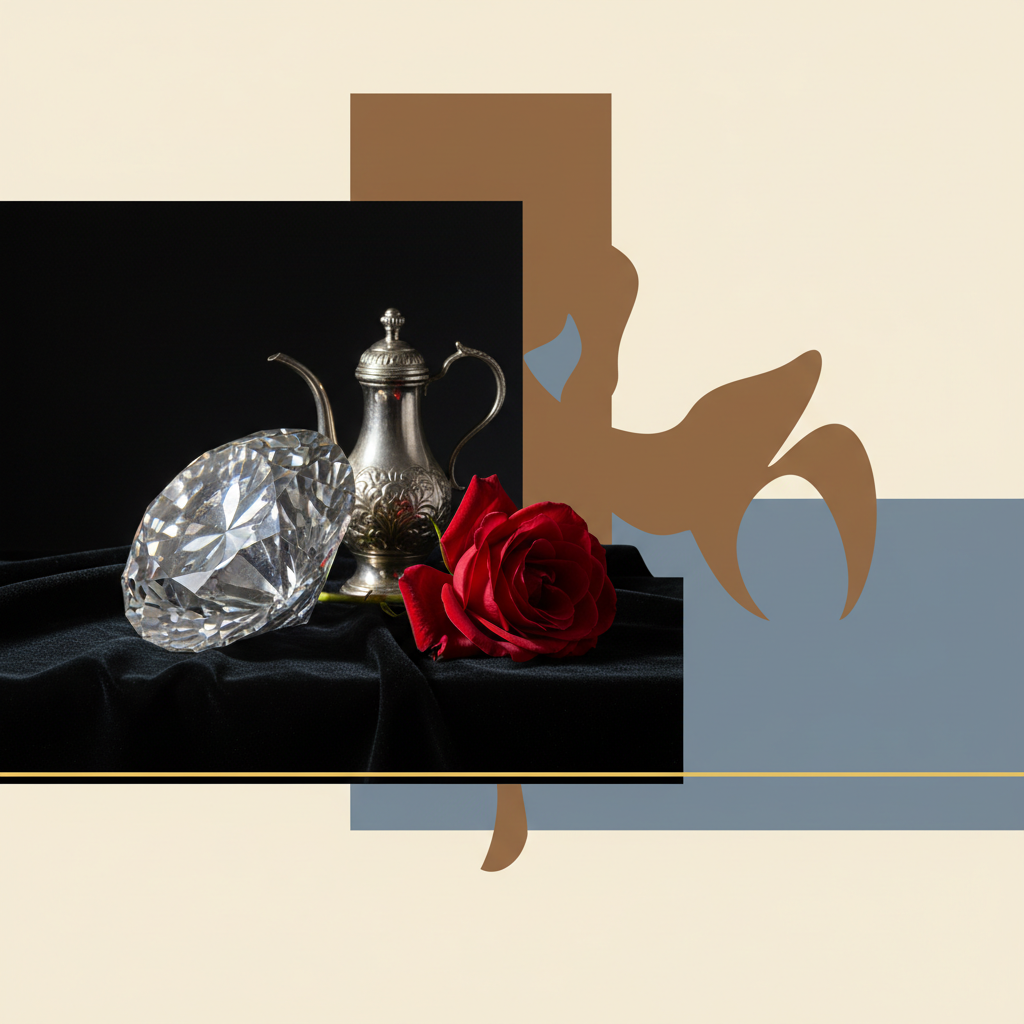
The jewels tell the same story. The Golconda mines produced diamonds of an optical purity—Type IIa, completely devoid of nitrogen—that gave the stones an eerie, limpid transparency. Yet the courts rarely cut them into European facets, which sacrifice stone volume for superficial sparkle. Instead, gem-carvers worked with the crystal's native architecture, engraving royal titles and Quranic verses directly into emerald cabochons and spinels with diamond-tipped drills. The reverse of these pieces was routinely coated in meenakari, an intricate polychrome enamel of birds, blossoms, and hunting scenes. The finest enamel work was reserved for the side that touched the skin, invisible to onlookers. Elegance was an intimate standard, not a public performance.
When the back of a necklace is more intricately worked than the front, you are looking at a society that values the wearer's private experience above public ostentation.
This pursuit of tactile refinement carried straight into daily ritual through scent. The Persianate court was an olfactory culture. The distillation of ittar in Kannauj—extracting the scent of damask rose, wild vetiver (khus), or the dry earth itself (mitti) into a base of pure sandalwood oil—was an empirical science. Scent was layered onto the body, infused into architectural mortar, and burnt through agarbatti to mark different hours of the day. Noor Jahan's refinement of rose distillation was not a casual hobby; it was an exercise in industrial chemistry driven by a desire for sensorial perfection.
Beauty rituals were comprehensive protocols. The body was treated as an instrument requiring maintenance, balance, and deliberate care. Pastes of crushed saffron, sandalwood, almond flour, and fresh cream were not cosmetic conceits meant to mask; they were formulations developed over centuries of Ayurvedic and Unani practice to cool the skin, preserve elasticity, and mitigate the heat of the plains. Kajal was prepared from the soot of castor-oil lamps infused with camphor to clarify the eyes while framing them.
The coloniser wrote of these courts as effete and decadent, because an industrial mind confused material refinement with weakness. They mistook an obsession with finish, fragrance, and equilibrium for decay.
In reality, the output of these ateliers reveals an elevated society at its peak: one where architecture, metallurgy, and botanical knowledge were harnessed not merely to survive the world, but to elevate every waking hour spent within it.
TL;DR
Colonial records routinely dismissed the Indian and Persianate worlds as chaotic or decadent to justify their extraction. The material record—from Dhaka muslins and Golconda gems to hydraulic gardens and bespoke distillation—reveals an advanced civilisational mastery of the senses. Real elegance is measured by what a society creates when it decides beauty is worth serious intellectual effort.