Medicine, mathematics and the stars: the science they called superstition
Colonial education systematically reframed centuries of rigorous Indian and Islamic mathematics, medicine, and astronomy as native superstition to justify foreign rule.
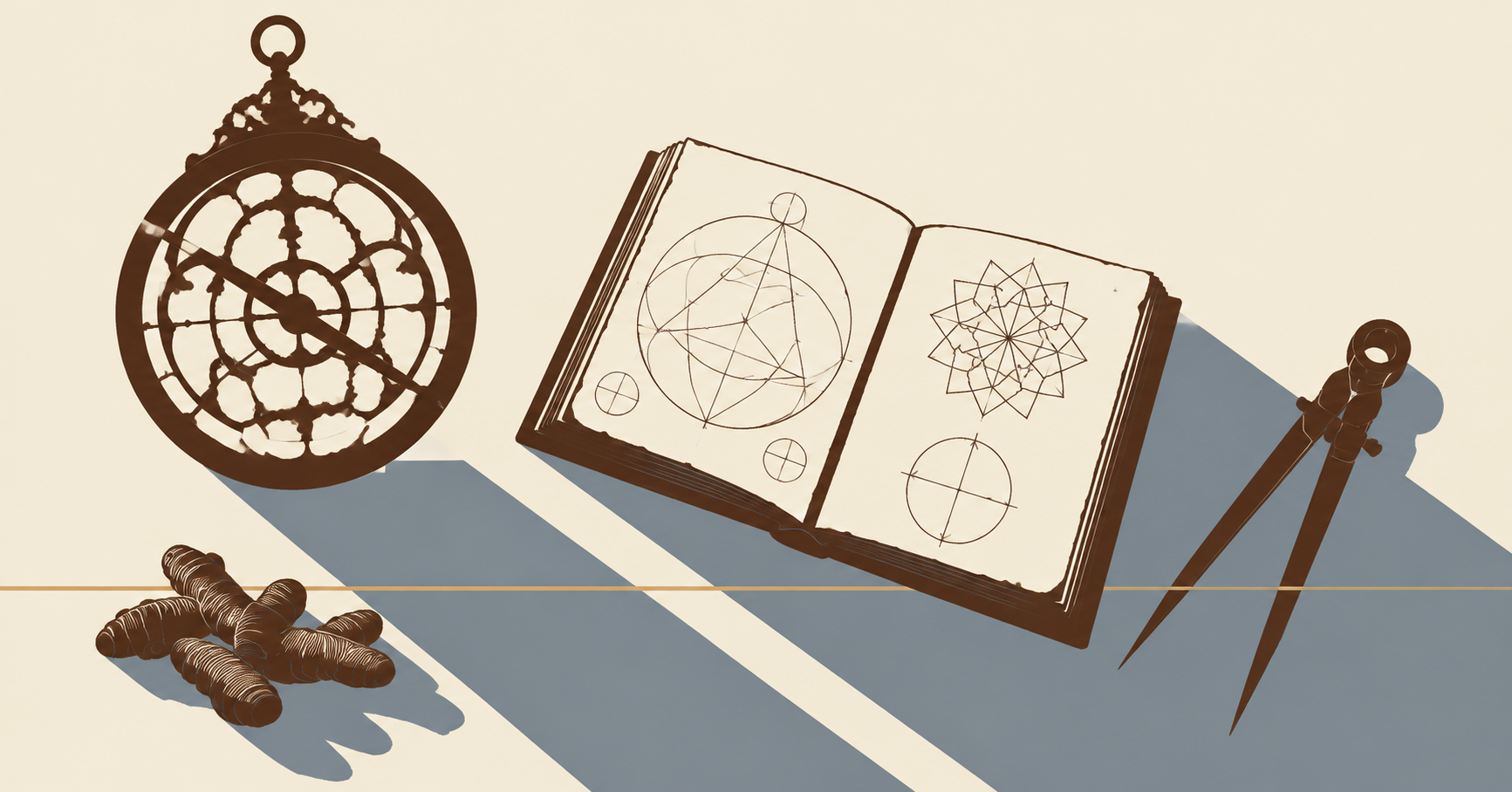
When colonial administrators arrived in South Asia, they brought an entire epistemological apparatus designed to classify what they encountered. If an indigenous system of inquiry could not be mapped directly onto the curriculum of an English public school or the edicts of the Royal Society, it was filed under native folklore. At worst, it was dismissed as heathen superstition.
This was not a failure of translation. It was an administrative strategy. The coloniser needed to establish intellectual supremacy to justify bureaucratic rule. To admit that the people you subjugated possessed empirical traditions older, and in several disciplines far more sophisticated, than your own would undermine the entire moral pretext of empire.
So, empirical traditions became rituals. Mathematics became mysticism. Medicine became quackery.
The Indian subcontinent gave the world the zero as a functioning arithmetic operator, along with the base-ten positional system that made modern computation possible. Brahmagupta formalised the rules for arithmetic operations with zero in the seventh century. Centuries earlier, Aryabhata calculated the value of pi to four decimal places, proposed that the Earth rotated on its axis, and worked out the true cause of solar and lunar eclipses while European clerics were still treating astronomical anomalies as direct omens from God.
Across the wider Islamic world, these mathematical foundations were received, integrated, and extended. Al-Khwarizmi took Hindu numerals, refined them, and developed systematic algebraic methods for solving linear and quadratic equations. Ibn al-Haytham dismantled classical Greek optical theory by running controlled physical experiments with light, establishing what we now recognise as the basis of empirical optics.
The coloniser needed to establish intellectual supremacy to justify bureaucratic rule, flattening centuries of systematic inquiry into mere native folklore.
This was rigorous, peer-reviewed, reproducible work. It used mathematical proof and observational correction. Yet Thomas Babington Macaulay could sit in Calcutta in 1835 and write with straight-faced arrogance that a single shelf of a good European library was worth the whole native literature of India and Arabia. His infamous Minute on Indian Education did not merely replace Persian and Sanskrit with English. It systematically delegitimised indigenous epistemologies through the curriculum, teaching generations of colonised subjects to view their own scientific inheritance as archaic mumbo-jumbo.
Consider surgery. The Sushruta Samhita, compiled centuries before the Common Era, detailed systematic surgical procedures that included cataracts, kidney stones, and rhinoplasty. Sushruta taught his students to practise incisions on watermelons, clay pots, and animal hides before touching human skin. He categorised over a hundred surgical instruments, categorised wound management techniques, and understood the importance of clean margins.
When British surgeons in the eighteenth century witnessed Indian practitioners reconstruct noses using forehead flaps, an operation derived directly from Sushruta’s techniques, they were astonished. They took the method back to London, published it in The Gentleman's Magazine, and eventually credited European practitioners with inventing modern plastic surgery. Meanwhile, the indigenous school that preserved the technique was starved of official patronage, pushed to the margins of public healthcare, and classified as backward village custom.
The same dismissive lens was applied to Unani medicine, the Greco-Arabic synthesis developed by physicians such as Ibn Sina and refined over centuries of practice across South Asia and the Middle East. Unani and classical Ayurveda were institutional traditions. They had diagnostic protocols, extensive pharmacopeias, and clinical training. They analysed constitution, diet, environment, and pharmacology in systematic detail.
Instead of studying these frameworks on their own merits, the colonial state treated them as quaint relics that needed purging. If a treatment relied on an unfamiliar systemic framework rather than Western anatomical models, the British medical establishment branded it charlatanism, even while their own physicians were still prescribing mercury and bleeding patients with leeches.
Metallurgy suffered an identical fate. The Wootz steel of southern India, exported across the Indian Ocean and transformed into the fabled Damascus blades, baffled European metallurgists for decades. It was crucible steel with high carbon content, produced through precise temperature regulation and specific botanical fluxes. The iron pillar of Delhi, erected in the fourth century, stands in open air with virtually no corrosion, a demonstration of advanced forge-welding and high-phosphorus metallurgic control. The British observed it, marvelled at the oddity, and filed it away as an inexplicable lucky accident rather than the product of an organised industrial science.
When an astronomical complex operates on stone rather than brass, the European observer sees an eccentric temple rather than an empirical instrument.
Look at Jantar Mantar. In the early eighteenth century, Maharaja Jai Singh II built five monumental astronomical observatories across northern India. He chose massive masonry instruments over small brass telescopes because he found the European instruments of his day too unstable for the precise, repeatable positional measurements he required.
The Samrat Yantra at Jaipur could measure local time to within two seconds. The instruments tracked eclipses, planetary declinations, and equinoxes with staggering exactness. Yet nineteenth-century colonial observers routinely described these complexes as bizarre astrological playgrounds. When an astronomical complex operates on stone rather than brass, the European observer sees an eccentric temple rather than an empirical instrument.
The tragedy of colonial education is how deeply it took root. It produced a class of administrators and intellectuals who looked at their own scientific history through the coloniser's spectacles. They conflated empirical traditions with theological dogma, throwing out centuries of systematic observation because it arrived wrapped in vernacular texts.
Reclaiming this history is not an exercise in romantic nostalgia. It is an administrative audit of what was systematically stolen, rewritten, or relegated to the scrapheap of native superstition.
TL;DR
Colonial education deliberately reframed centuries of rigorous Indian and Islamic scientific inquiry as mystical superstition to justify foreign rule. From positional mathematics and advanced reconstructive surgery to metallurgy and masonry astronomy, foundational empirical sciences were degraded, appropriated, or scrubbed from institutional curricula. Reclaiming these achievements is simply a matter of historical accuracy.