Trees as monuments, coral as memory
We build museums around 200-year-old castles and clear-cut 1,000-year-old trees for parking lots. Our conception of history is broken; it is a logic of preservation for the made, and destruction for the grown.
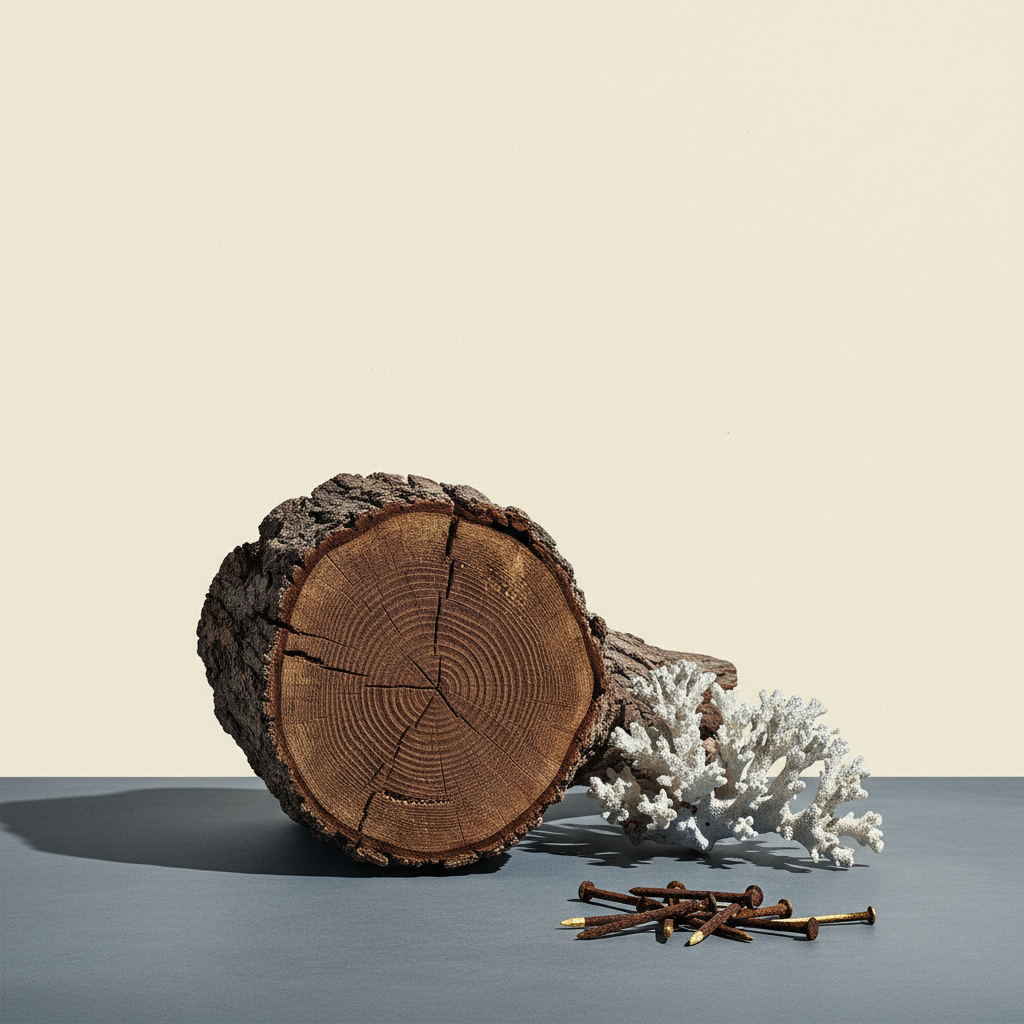
'''Our thinking about monuments is broken. We see a 200-year-old castle, rightly, as a piece of history to be preserved. We put a rope around it, charge for entry, and call it a heritage site. Then we approve the plans for a new car park by clear-cutting a forest, felling a stand of 1,000-year-old trees in the process. The castle saw two centuries. The trees saw ten. Yet we see one as a monument and the other as timber.
This is a profound failure of imagination. It is a symptom of a deep detachment from the world as it is, a worldview that only grants historical significance to the things we build ourselves. We see history as something that happens to the landscape, not with it. The human artefact is sacred; the living system that predates it is disposable.
What is an ancient oak if not a monument? It is a living chronicle of the place it occupies. Its rings are a dense, detailed record of droughts, floods, fires, and calm seasons. It has stood witness to the entire arc of modern history, a silent observer of our frantic, short-lived endeavours. To fell it for floorboards or a parking space is not merely an act of destruction. It is an act of erasure, deleting a record we can never recover.
It tells a story of resilience that no human structure can match. Old buildings are propped up, restored, patched. An old tree stands on its own terms, a self-contained system of survival. It wears its history on its bark, in its gnarled branches. It is a testament to a timescale we are institutionally incapable of comprehending.
Then there is the coral reef, a different kind of living memorial. A reef is not a single entity, but a sprawling, collaborative metropolis of organisms built over millennia. It is memory made manifest, a calcified record of the ocean's currents, its temperatures, its inhabitants. Each intricate structure is a chapter in a story that began long before our species learned to write.
The death of a reef is not just an ecological catastrophe. It is a form of collective amnesia. We are losing libraries we have not yet learned to read. We speak of它们的灭绝 in terms of biodiversity loss, a clinical, detached framing. We should speak of it as the burning of Alexandria, the sacking of a great city of memory.
Perhaps we need a new kind of memorialisation, one that acknowledges absence. Not a plaque on a visitor centre wall, but a designated space for reflection. A sign on a barren coast that reads, 'Here once thrived a reef. You'll have to close your eyes.' The act of remembrance becomes an active process, a conscious effort to conjure what has been lost and to understand the scale of its absence.
This isn't about inducing guilt. It is about recalibrating our values. It is about expanding our definition of history to include the stories written in wood, in stone, and in the accumulated lives of a million tiny creatures. When we see a veteran tree not as a resource to be exploited but as an elder to be respected, our decisions about the world change.
We would no more think of felling it for a minor convenience than we would of demolishing a cathedral for a better view.
Our present logic builds new worlds on the rubble of old ones, but has forgotten that the oldest worlds are still living.'''
TL;DR
We build museums around 200-year-old castles and clear-cut 1,000-year-old trees for parking lots. Our conception of history is broken; it is a logic of preservation for the made, and destruction for the grown.